East Asia Blog Series

How Will the Conflict in the Middle East Affect Economies in Asia and the Pacific?

Albert Park, Matteo Lanzafame 10 Mar 2026
Surging energy costs hurt household incomes, raise manufacturing and logistics costs, stoke inflation, and weigh on economic growth. IADE-Michoko

Surging fuel prices and disruption to shipping risk widespread fallout across the region, but policymakers should resist market intervention in favor of support measures for vulnerable groups.

Geopolitical risk is again at the center of the global economic outlook. While Asia and the Pacific has limited direct trade exposure to Iran and neighboring countries, it could still face significant adverse economic consequences. Disruptions in the Middle East can ripple out to Asian economies through multiple channels. Policymakers across the region should be prepared to respond to potential shocks to energy prices, trade flows, and financial conditions.

Historically, conflicts in the Middle East have affected the global economy primarily through oil supply disruptions. Today, the risks are broader. The current crisis highlights vulnerabilities not only in energy production but also in global transport networks for oil, gas, goods, and people.

The Strait of Hormuz—a narrow waterway connecting the Persian Gulf with global markets—plays a crucial role in global energy trade. Around 20% of globally traded oil and liquefied natural gas passes through it, and roughly 80% of those shipments ultimately head to Asia. This means that even partial disruptions can have significant consequences for economies in the region.

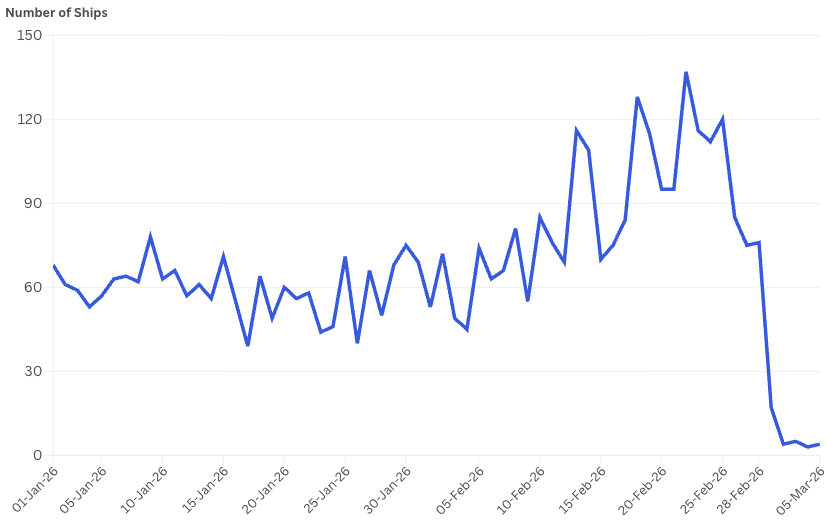
Shipping data indicate that vessel traffic through the Strait of Hormuz has fallen sharply as companies reassess security risks. Insurance costs for ships have risen. Freight rates for transporting crude oil from the Middle East to Asia have increased significantly.

For Asian economies that depend heavily on maritime trade—both for importing energy and exporting manufactured goods—such disruptions can quickly raise costs across entire supply chains.

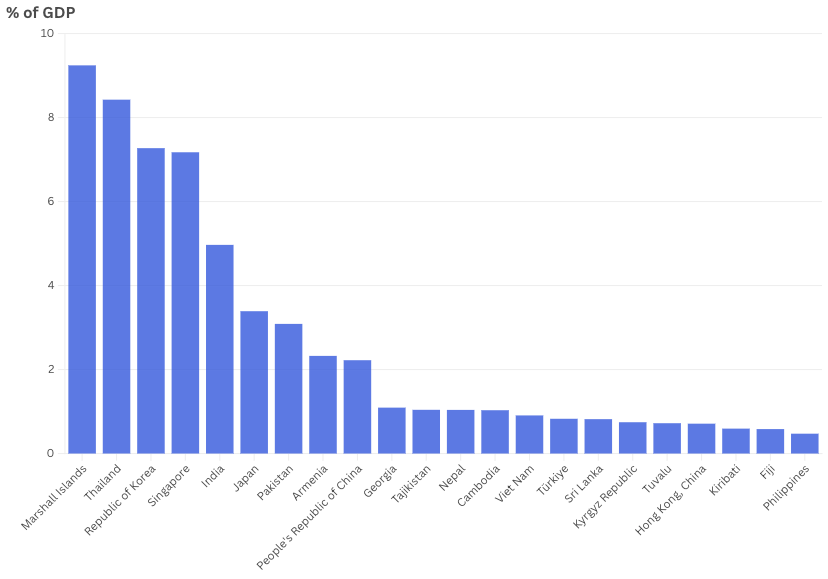
The most immediate economic impact, however, is likely to occur through energy prices. Asia is the world’s largest energy-importing region, with net oil and natural gas imports exceeding 2% of GDP in several economies. Even moderate increases in global energy prices can translate into sizable economic losses.

Net oil and gas imports as a share of GDP (%, average 2022-24), Asia and the Pacific

Note: Data refers to the sum of HS Code 2709 (crude petroleum oils and oils obtained from bituminous minerals) and HS Code 2711 (petroleum gases and other gaseous hydrocarbons, including natural gas and liquefied petroleum gases [LPG]). Net imports are calculated as the difference between imports and exports, and expressed as a share of GDP in current US dollars. Sources: ADB staff calculations using data from the CEPII-BACI dataset; World Bank. World Development Indicators online database.

Attacks on energy infrastructure in the Middle East and concerns about disruptions to shipping routes have already pushed energy prices higher. Between 28 February and 9 March, Brent crude oil prices surged by about 45%, with natural gas prices also spiking sharply.

Higher energy prices affect economies in several ways. For households, rising fuel and electricity costs reduce purchasing power. For businesses, higher transport and production costs squeeze profit margins. For central banks and governments, the challenge becomes managing inflation and fiscal sustainability without undermining economic growth.

Geopolitical shocks also affect financial markets. Periods of uncertainty typically lead investors to seek safe-haven assets, strengthening the US dollar and tightening global financial conditions.

Daily traffic through the Strait of Hormuz (1 January to 5 March 2026)

Source: IMF Portwatch.

For many Asian economies, this creates additional challenges. Because oil is priced in dollars, a stronger dollar can increase the domestic currency cost of energy imports. At the same time, tighter global financial conditions—including through widening sovereign spreads—can raise borrowing costs and reduce capital inflows, particularly in more vulnerable emerging markets.

Not all economies in Asia face the same level of risk. Large energy-importing economies—including the People’s Republic of China (PRC), India, Japan, and the Republic of Korea—are particularly exposed because of their heavy dependence on imported crude oil. The PRC alone imports around 11 million barrels of oil per day, making it the world’s largest oil importer.

Some smaller economies dependent on fossil fuel imports may be even more vulnerable because of relatively high macroeconomic sensitivity. Countries such as Pakistan, Sri Lanka, and Thailand rely heavily on imported energy, and rising oil prices can quickly translate into higher inflation and pressure on current accounts and exchange rates.

Exposure alone does not determine vulnerability. The availability of emergency oil stocks, commonly referred to as Strategic Petroleum Reserves, materially affects how long economies can cushion an energy supply disruption. Japan, the Republic of Korea, and the PRC have several months of reserves, while India’s reserves are somewhat less. Tourism-dependent economies such as Maldives, Sri Lanka, Thailand, and Pacific economies may face additional risks if aviation disruptions persist. Airspace closures across parts of the Middle East have already forced airlines to reroute flights, potentially affecting tourism flows and air cargo shipments.

The overall economic impact will depend on how the conflict evolves. If tensions remain contained and major shipping routes stay open, the economic effects may be limited mainly to higher energy prices and increased market volatility.

However, a more severe escalation—particularly one involving prolonged disruptions to the Strait of Hormuz—could have more significant consequences. Sustained disruptions could push oil prices much higher, weaken global trade, and slow economic growth.

The policy response should focus on stabilization rather than suppressing price signals. Shielding consumers from higher domestic energy costs through price controls or subsidies could distort market incentives and undermine the efficient allocation of resources. To protect vulnerable groups, targeted support is needed.

Central banks should prioritize reducing excessive swings in exchange rates and liquidity provision before tightening monetary policy aggressively, especially where inflationary pressures originate externally. Premature or excessive policy tightening could suppress growth and exacerbate financial volatility.

Governments can also play a role by monitoring early warning signs—such as shipping costs, aviation disruptions, and financial market volatility—that may signal deeper economic stress.

Economies in Asia and the Pacific have shown remarkable resilience to global shocks in recent years. To better withstand new challenges caused by the current conflict in the Middle East, it will be critical to strengthen energy security, diversify supply chains, and maintain sound macroeconomic policies.
Picture of Albert Park

Albert Park

Chief Economist and Director General, Economic Research and Development Impact Department (ERDI)

Picture of Matteo Lanzafame

Matteo Lanzafame

Director, ADB Macroeconomics Research Division, Economic Research and Development Impact Department

Reproduced from Development Asia.

Is this piece helpful?
YesNo

© 2026 Regional Knowledge Sharing Initiative. The views expressed on this website are those of the authors and presenters and do not necessarily reflect the views and policies of the Asian Development Bank (ADB), its Board of Governors, or the governments they represent. ADB does not guarantee the accuracy of the data in any documents and materials posted on this website and accepts no responsibility for any consequence of their use. By making any designation of or reference to a particular territory or geographic area, or by using the term “country” in any documents posted on this website, ADB does not intend to make any judgments as to the legal or other status of any territory or area.