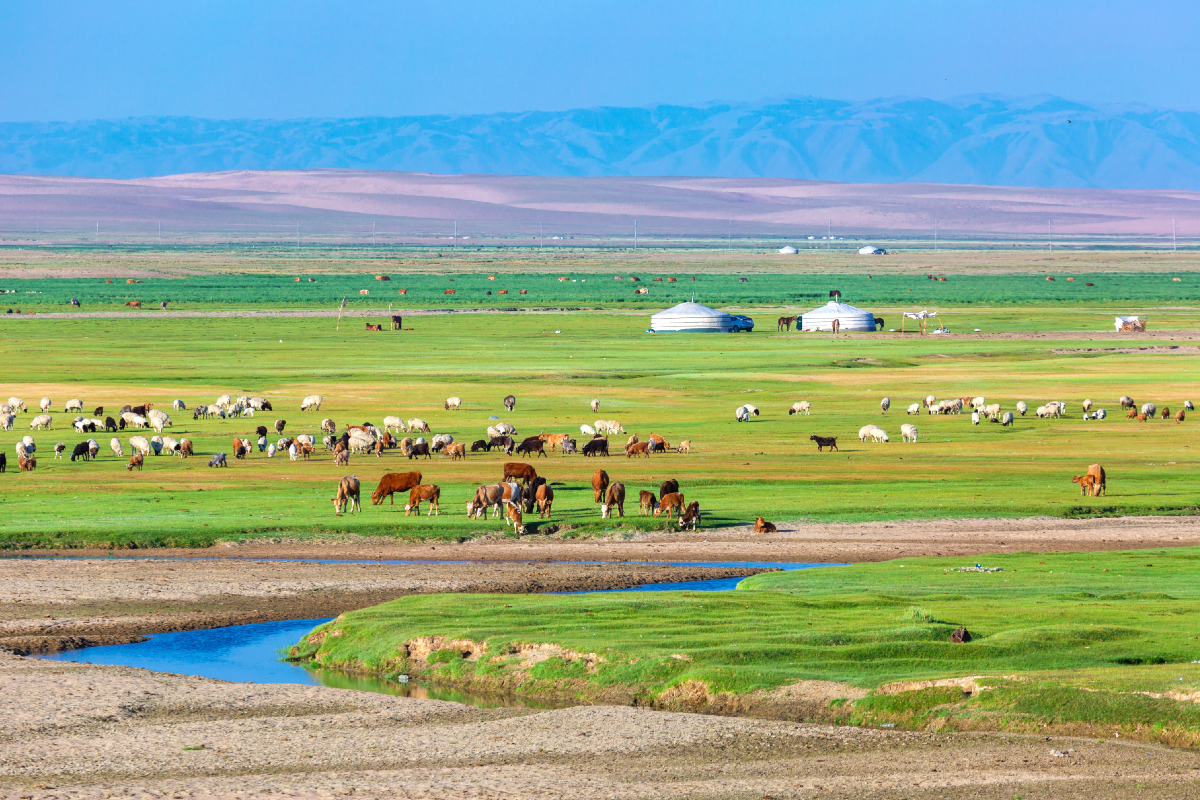
BEIJING, PEOPLE’S REPUBLIC OF CHINA – Long-term investment, better policies, and targeted restoration can restore grasslands, stabilize ecosystems and protect livelihoods across Asia and the Pacific.
Temperate grasslands are vital ecosystems that support rural livelihoods in Mongolia, the People’s Republic of China (PRC) and many other countries.
In Mongolia, grasslands cover nearly 80% of the territory and are essential for the nomadic herding lifestyle of one-third of the population. In the People’s Republic of China, they account for almost 40% of the land area, supporting more than 18 million herders and pastoral households.
These grasslands provide important ecosystem services, which are the benefits derived from nature such as food, clean air and water, plants and wildlife. In this case, these benefits include carbon storage, water regulation, and biodiversity conservation. They also serve as significant carbon sinks, storing carbon in vegetation and soil.
By regulating water flows and preventing soil erosion, grasslands protect freshwater resources and enhance land productivity, offering habitat for countless wildlife species. Preserving grasslands is crucial for sustaining livelihoods, ensuring food security, and building resilience against extreme weather.
Decades of overgrazing and poor land management have led to widespread degradation in many countries.
Grassland restoration projects in the People’s Republic of China emphasize that the recovery of native grassland ecosystems should take precedence over introducing incompatible or short-lived technological fixes. Experts highlight the importance of ecological integrity, sustainability, and tailoring interventions to local conditions.
Large-scale programs in the People’s Republic of China combine the restoration of degraded grasslands, sand fixation technologies, and community engagement to combat desertification. These approaches underscore the importance of coherent policies and long-term investment in land restoration. Solutions such as rotational grazing, grass reseeding, and payment for ecosystem services show how economic incentives can align with ecological goals.
Stable, long-term domestic financing is needed to achieve Mongolia’s grassland restoration goals. Despite strong policy commitments, institutional and financial constraints limit vital actions, such as reducing livestock stocking rates, establishing rotational grazing systems, and allowing resting periods for degraded grasslands.
Without predictable and sustained financing, progress will remain fragmented and vulnerable to short-term funding cycles, undermining Mongolia’s ecological and resilience goals.
There is a high cost to delayed restoration. Rehabilitation of severely degraded rangelands costs roughly $13,000 per hectare.
With Mongolia’s 12 million hectares of degraded rangelands, this poses a significant future financial burden. Early, low-cost interventions offer the greatest returns by preventing irreversible ecological decline and substantially reducing future restoration costs by one-third.
There is also a need for a combination of top-down policy direction with bottom-up innovation, starting with targeted pilot programs supported by policies and testing, while refining approaches on the ground, and scaling up based on lessons learned.
Simply banning grazing creates conflicts. It is essential to create new opportunities for herders before implementing restrictions.
Mongolia aims to adopt an integrated approach by increasing investment in rangeland restoration, strengthening policies for sustainable grazing management, and promoting grassland-based livestock products and services.
The People’s Republic of China is transforming its livestock sector to a greener, lower-carbon, and higher-quality production system. This is being done through certified organic and eco-labeled products. These measures align ecological objectives with rural income growth.
Tools such as eco compensation and joint public-private funding show how financing can be broadened through a mix of public, private, and philanthropic sources. These approaches can spark long-term investment and draw in companies, cooperatives, and other groups working on land restoration and water management.
Techniques such as rainwater harvesting and efficient irrigation are also crucial for sustaining grasslands amid changing environmental conditions.
Remote sensing is used in the People’s Republic of China for ecological monitoring and early warning, offering practical models for data-driven environmental governance. This offers opportunities to enhance monitoring systems, support data-driven decision-making, and strengthen preparedness for environment-related risks.
By building on these insights, Mongolia and other countries facing such issues have a unique opportunity to champion a future where rangelands thrive, supporting biodiversity, resilience, and the livelihoods of millions across the region.
The blog post is based on findings from a study tour for senior government officials of Mongolia to the People’s Republic of China, funded by the Regional Knowledge Sharing Initiative, as Mongolia hosts the 17th Conference of the Parties to the United Nations Convention to Combat Desertification.