The 9th CAREC Think Tank Development Forum and Tianshan Forum on Central Asia Economic Cooperation

The 9th CAREC Think Tank Development Forum themed “Accelerating Transformative Effect of Green Initiatives through Innovative Financing Mechanisms in the CAREC Region,” it aims to foster meaningful policy dialogue, facilitate knowledge exchange, and advance the green transition in the CAREC region through innovative financing solutions. The forum featured key aspects of the green transition, including innovative financing models, green banking, sustainable lending practices, and climate finance. It brought together over 150 participants from government, international organizations, the private sector, think tanks, and academia. The experts shared diverse insights on how financial institutions can mobilize capital for sustainable development and highlighted the critical role of international donors in supporting climate finance.

The Tianshan Forum for Central Asia Economic Cooperation focused on “Unlocking Connectivity and Investment in Central Asia.” It is dedicated to catalyzing investment in the CAREC region by fostering policy dialogue, knowledge sharing, and strong stakeholder collaboration. Lan Fo’an, Minister of Finance of the PRC and Yingming Yang, Vice President of ADB delivered opening remarks. Aiming Zhou, Deputy Country Director of ADB PRC Resident Mission delivered keynote speeches. The forum brought together over 380 participants, including senior government officials, representatives of international organizations, financial institutions, and the private sector, and experts from think tanks and academic institutions.

The two events are organized in Urumqi on 1 December and 2-3 December 2025 respectively. 

How Stable Financing and Sustainable Grazing Can Restore Grasslands

Early, well-financed, and locally tailored grassland restoration delivers economic and ecological returns. Photo: Tseelei Damjin

BEIJING, PEOPLE’S REPUBLIC OF CHINA – Long-term investment, better policies, and targeted restoration can restore grasslands, stabilize ecosystems and protect livelihoods across Asia and the Pacific.

Temperate grasslands are vital ecosystems that support rural livelihoods in Mongolia, the People’s Republic of China (PRC) and many other countries.

In Mongolia, grasslands cover nearly 80% of the territory and are essential for the nomadic herding lifestyle of one-third of the population. In the People’s Republic of China, they account for almost 40% of the land area, supporting more than 18 million herders and pastoral households.

These grasslands provide important ecosystem services, which are the benefits derived from nature such as food, clean air and water, plants and wildlife. In this case, these benefits include carbon storage, water regulation, and biodiversity conservation. They also serve as significant carbon sinks, storing carbon in vegetation and soil.

By regulating water flows and preventing soil erosion, grasslands protect freshwater resources and enhance land productivity, offering habitat for countless wildlife species. Preserving grasslands is crucial for sustaining livelihoods, ensuring food security, and building resilience against extreme weather.

Decades of overgrazing and poor land management have led to widespread degradation in many countries.

Grassland restoration projects in the People’s Republic of China emphasize that the recovery of native grassland ecosystems should take precedence over introducing incompatible or short-lived technological fixes. Experts highlight the importance of ecological integrity, sustainability, and tailoring interventions to local conditions.

Large-scale programs in the People’s Republic of China combine the restoration of degraded grasslands, sand fixation technologies, and community engagement to combat desertification. These approaches underscore the importance of coherent policies and long-term investment in land restoration. Solutions such as rotational grazing, grass reseeding, and payment for ecosystem services show how economic incentives can align with ecological goals.

Stable, long-term domestic financing is needed to achieve Mongolia’s grassland restoration goals. Despite strong policy commitments, institutional and financial constraints limit vital actions, such as reducing livestock stocking rates, establishing rotational grazing systems, and allowing resting periods for degraded grasslands.

Without predictable and sustained financing, progress will remain fragmented and vulnerable to short-term funding cycles, undermining Mongolia’s ecological and resilience goals.

There is a high cost to delayed restoration. Rehabilitation of severely degraded rangelands costs roughly $13,000 per hectare.

With Mongolia’s 12 million hectares of degraded rangelands, this poses a significant future financial burden. Early, low-cost interventions offer the greatest returns by preventing irreversible ecological decline and substantially reducing future restoration costs by one-third.

There is also a need for a combination of top-down policy direction with bottom-up innovation, starting with targeted pilot programs supported by policies and testing, while refining approaches on the ground, and scaling up based on lessons learned.

Simply banning grazing creates conflicts. It is essential to create new opportunities for herders before implementing restrictions.

Mongolia aims to adopt an integrated approach by increasing investment in rangeland restoration, strengthening policies for sustainable grazing management, and promoting grassland-based livestock products and services.

The People’s Republic of China is transforming its livestock sector to a greener, lower-carbon, and higher-quality production system. This is being done through certified organic and eco-labeled products. These measures align ecological objectives with rural income growth.

Tools such as eco compensation and joint public-private funding show how financing can be broadened through a mix of public, private, and philanthropic sources. These approaches can spark long-term investment and draw in companies, cooperatives, and other groups working on land restoration and water management.

Techniques such as rainwater harvesting and efficient irrigation are also crucial for sustaining grasslands amid changing environmental conditions.

Remote sensing is used in the People’s Republic of China for ecological monitoring and early warning, offering practical models for data-driven environmental governance. This offers opportunities to enhance monitoring systems, support data-driven decision-making, and strengthen preparedness for environment-related risks.

By building on these insights, Mongolia and other countries facing such issues have a unique opportunity to champion a future where rangelands thrive, supporting biodiversity, resilience, and the livelihoods of millions across the region.

The blog post is based on findings from a study tour for senior government officials of Mongolia to the People’s Republic of China, funded by the Regional Knowledge Sharing Initiative, as Mongolia hosts the 17th Conference of the Parties to the United Nations Convention to Combat Desertification.

Picture of   Alexandra Vogl

Alexandra Vogl

Principal Climate Change Specialist, ADB Climate Change and Sustainable Development Department

Picture of Enkh-Amgalan Tseelei

Enkh-Amgalan Tseelei

Senior Climate Change Officer, ADB Mongolia Resident Mission

Picture of Lin Ji

Lin Ji

Senior Climate Change Officer, ADB's Resident Mission in People's Republic of China\

Reproduced from blogs.adb.org.

Driving Change Workshop in the PRC Concludes with Key Lessons on Sustainable Finance

Speakers and presenting participants of the regional workshop, “Driving Change: Lessons from Breakthroughs in Innovative and Sustainable Finance in the PRC,” held in Beijing. The photo includes experts from the People’s Republic of China and representatives from Azerbaijan, Georgia, Indonesia, Mongolia, the Philippines, Thailand, Uzbekistan, and Viet Nam, who shared experiences and insights on advancing sustainable finance.

BEIJING, PEOPLE’S REPUBLIC OF CHINA (23-24 October 2025) – The two-day regional workshop, Driving Change: Lessons from Breakthroughs in Innovative and Sustainable Finance in the PRC, brought together participants from Azerbaijan, Georgia, Indonesia, Mongolia, the Philippines, Thailand, Uzbekistan, Viet Nam, and the People’s Republic of China. Organized by the Asian Development Bank (ADB) in Beijing, the event convened government officials, regulators, and financial institutions to exchange practical experiences in advancing green and transition finance.

Across eight sessions, participants discussed China’s experience in developing policy frameworks, taxonomies, and innovative financial instruments such as sustainability-linked loans and transition finance. They also examined disclosure practices, digital tools, and sectoral approaches—including agriculture and manufacturing—that can inform strategies in other countries.

Participants learned from China’s pioneering pilots and shared their own policy and market experiences, offering perspectives on how sustainable finance principles can be adapted to different economic contexts. Discussions underscored three key messages: credibility and clear standards are essential to build investor trust, solutions must reflect each country’s unique realities, and regional collaboration can help scale successful innovations.

The workshop concluded with a shared recognition that sustained cooperation and knowledge exchange are critical to accelerating the region’s transition toward sustainable and inclusive growth.

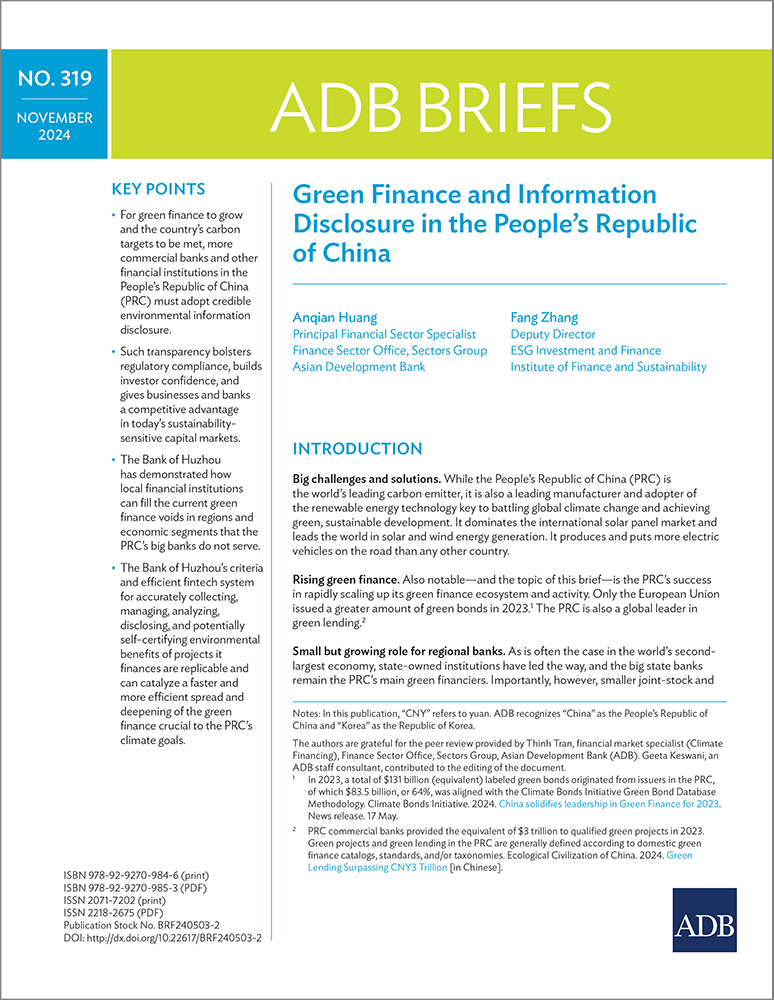
Green Finance and Information Disclosure in the People’s Republic of China

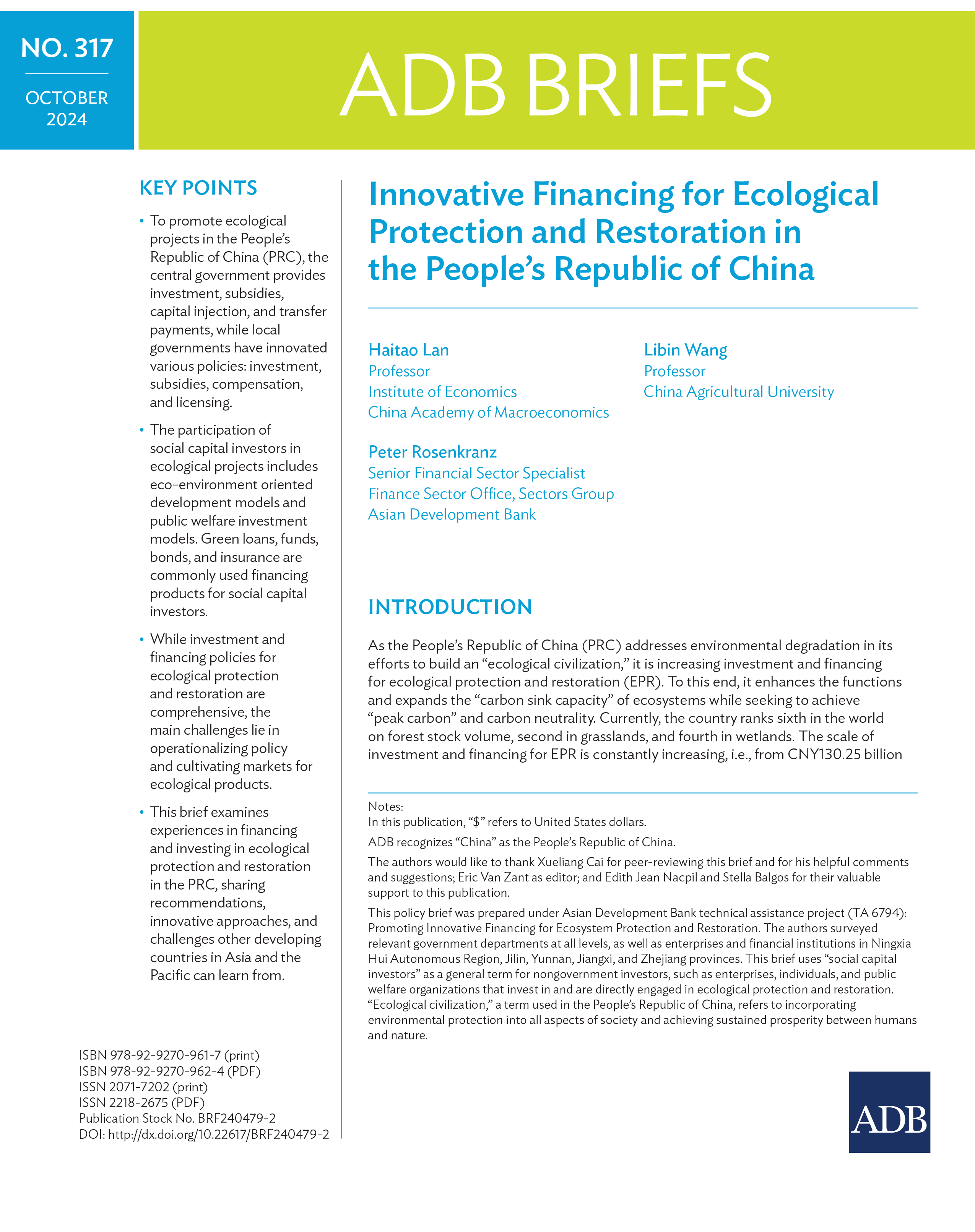
Innovative Financing for Ecological Protection and Restoration in the People’s Republic of China

© 2026 Regional Knowledge Sharing Initiative. The views expressed on this website are those of the authors and presenters and do not necessarily reflect the views and policies of the Asian Development Bank (ADB), its Board of Governors, or the governments they represent. ADB does not guarantee the accuracy of the data in any documents and materials posted on this website and accepts no responsibility for any consequence of their use. By making any designation of or reference to a particular territory or geographic area, or by using the term “country” in any documents posted on this website, ADB does not intend to make any judgments as to the legal or other status of any territory or area.